The Niger Delta Oil War: What Does it Take to Get the World’s Attention?

In 2008, record shattering oil prices have invaded our daily lives and roused popular indignation, generating an avalanche of media attention and prompting much grasping at the mystifying complexities of oil pricing. Greedy oil companies, opportunistic commodity speculators, bleeding-heart environmentalists, the war in Iraq, OPEC, a callous congress, declining production in Mexico, Russia and Venezuela, Chinese and Indian growth, and, of course, terrorists – all have been “blamed” for skyrocketing prices at the pump. For most Americans, mention of “terrorism” and “oil” conjures an Arab face and perhaps a twinge of fear, but while the Bush administration has zeroed in on the Persian Gulf and the larger Middle East, Nigerian rebel gangs have been on a rampage, terrorizing Shell, Chevron-Texaco, the Nigerian government, and others – robbing, kidnapping, killing, sabotaging and setting fires – loudly and violently demanding their share of the immense wealth that flows from the oil-rich Niger Delta. This paper will examine Nigeria’s oil war, its origins and its psychology.
‘Nigeria’ is essentially a British invention, as the Yoruba leader Obafemi Awolowo wrote in 1947, “There are no ‘Nigerians’ in the same sense that there are ‘English,’ ‘Welsh’ or ‘French’. The word ‘Nigerian’ is merely a distinctive appellation to distinguish those who live within the boundaries of Nigeria and those who do not.” Still today, ‘Nigerian unity,’ let alone nationalism, is virtually non-existent. At the southern tip of Nigeria,
 the most populous country in Africa with nearly 140 million people, lies the densely populated Niger Delta, home to some 31 million people of more than 40 ethnic groups (Yoruba, Hausa and Igbo are the most prominent) speaking some 250 dialects. Here, juxtaposed against the gleaming wealth of foreign oil companies and the ostentation of corrupt politicians, is abject poverty. With 70% of the population living on less than a dollar a day, a median age of 18, a life expectancy of 47, and millions living in shantytowns without electricity or fresh water, resentment has long been simmering.
The History of Oil in the Niger Delta
Nigeria produces more oil than any other African nation and is currently the 4th largest supplier of oil to the US (roughly 10% of imports at full Nigerian capacity). Massive theft and smuggling, however, have cut production nearly in half and have catapulted the issue up the international agenda (Nigerian President Umaru Yar’Adua claims output will rise by 1.2 million barrels when security returns, with a goal of 4 million barrels/day by 2010). Oil was first discovered in the 70,000 sq. km. Niger Delta wetlands area in 1956 at Oloibiri (Bayelsa State) by Royal Dutch Shell-BP (henceforth Shell). One year later Shell began construction of oil extraction infrastructure,
 and began construction of its first refinery by 1965 in the Rivers State capital of Port Harcourt, what would become Nigeria’s oil hub – with some 36 billion barrels of oil reserves; larger than the United States’ and Mexico’s combined. While in 1960, Nigeria was agriculturally self-sufficient and products such as palm oil (Rivers State was originally named Oil Rivers, palm oil that is!) and cacao beans made up nearly all of Nigeria’s exports, today they barely register as trade items and Nigeria imports more food than it produces as scrambling for oil wealth has become “the only game in town.” Perhaps no nation on earth better illustrates the “curse of the black gold.”
Oil Curse Par Excellence
By the mid-1970s, the poor African nation had joined OPEC and the government’s budget suddenly bulged with petrodollars from “Bonny Light,” the low sulfur, “sweet” Delta crude, easily refined into gasoline and diesel.

Despite the newfound wealth, a steady stream of migrants into the city of Port Harcourt did not find economic opportunity, or even a place to sleep, but rather found themselves settling ‘temporarily’ in small towns and villages just outside the city, clinging to the banks of creeks and rivers that form the labyrinthine water system of the Niger Delta wetlands – one of the largest in the world – sometimes in nothing more than mud-walled huts and rusty shacks in garbage heaped slums that stretch for miles. Throughout the 70s and 80s hundreds of communities like Oloibiri made pleas to the military government for schools, utilities and medicine, among other things, but at best received promises that went unfulfilled. When government money was forthcoming, most of the money was, according to Human Rights Watch in Nairobi “squandered on white elephant projects” – schools for the handicapped, fishponds for small-scale aquaculture, a sports stadium, many projects were either abandoned or never got started.
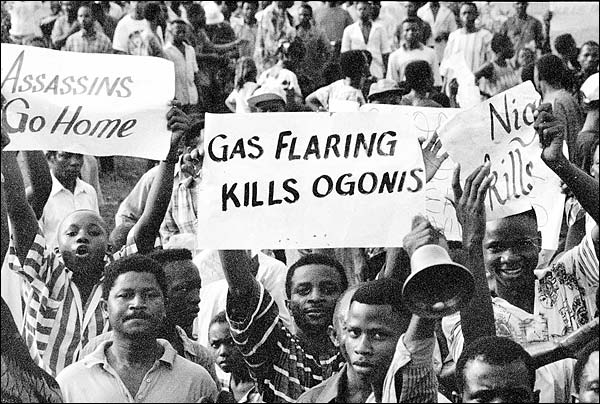 Though there were local protests, especially by the Ijaw the main ethnic group in the area, and even armed struggles from soon after Shell arrived, it was not until the early 1990s that the situation in the Delta began to receive attention outside Nigeria, first in the UK as Shell began to receive negative publicity.
Nothing to Lose
Far from benign neglect of the people, a 2001 Environmental Evaluation Review by the UK-based Ecumenical Council for Corporate Responsibility (ECCR) showed that about 300 oil spills occur annually, less than 50% of the spills are cleaned up and less than 25% remediated. The oil spills and runoff have drastically reduced the amount of arable land, contaminated ground water, polluted much of the rivers and killed off much of the fish that local diets and fishermen depended on. Acid rain has made rainwater undrinkable, and mangroves have been stripped away to make room for pipelines. All of this in a nation with a 68% literacy rate, where only 60% of children are enrolled in primary school, and where older students have little motivation to attend because there are no jobs, even for graduates. Gangs of marauding thugs, often drinking heavily, with machetes, sometimes with rifles or machine guns have become commonplace around Port Harcourt. It is no wonder then that such conditions breed anger and deep anti-Western resentment, the hooded rebel leader of the Movement for the Emancipation of the Niger Delta’s (MEND) hero: Osama Bin Laden. In Eghare W.O. Ojhogar, chief of the Ugborodo community’s words, "It is like paradise and hell. They have everything. We have nothing... If we protest, they send soldiers." This is not to say that all the violent rebels are inspired by genuine grievances and deserve our sympathy. Some are mere opportunists; stealing, smuggling and kidnapping foreign oil workers for ransom, to get rich. But like in Palestine, the mere existence of a righteous rallying cry aimed at an ‘occupying power’ is enough to blur the line between the criminal and the just, the terrorist and the freedom-fighter – and drive men indefatigably to acts of terrifying brutality.
Let the Wars Begin

Violence really took off in 2003 when local militias began increasing their sophistication and effectiveness. Cash-rich local politicians have compounded the problem by co-opting local militia groups because they proved useful as local muscle to take over voting offices and grab ballot boxes to control the periodic elections. The sense of relentless crisis deepened further in 2005, when MEND rebels, intensified night-time attacks on oil platforms and pumping stations, most of which were operated by Shell Nigeria. Militants from MEND and other groups have killed soldiers and security guards, kidnapped foreign oil workers, set off car bombs in the Delta city of Warri to protest the visit of Chinese oil executives, and even overran an oil rig 64 km. offshore in the Gulf of Guinea. With each disruption, the daily price of oil on the world market climbed. According to the Brussels-based International Crisis Group, escalating violence in a region teeming with angry, frustrated people is creating a "militant time bomb."
Most recently, on June 19th of 2008, MEND attacked an enormous oil facility 75 miles off the West African coast, traveling hours by speedboat in the middle of the night and kidnapping an oil worker in one of their most brazen assaults to date. Three days after the attack, Nigerian officials said at a hastily arranged global energy summit in Saudi Arabia, that recent attacks had cut Nigeria’s oil production to its lowest level in nearly two decades, sending oil prices ever higher. The recent upsurge prompted the Nigerian government to offer to meet with rebels in the South and since the 1990s, the oil companies have responded by building local amenities like roads, hospitals and schools to win local hearts and minds, though locals argue they are still seeing just a fraction of what is rightfully theirs. The key factor making stability unlikely is that the rebels have realized that they have weaponized oil and can influence world markets, for the first time – and with the only means at their disposal – they have gotten the world’s attention and they are not likely to give it up for a relative pittance the Nigerian government is likely to offer them.
Tomorrow Morning?
The early 2008 arrest of MEND rebel leader Henry Okah, seen as a hero by many in the Delta, and his ongoing secretive trial, as well as threats of a violent assault to free their leader, only offer menacing prospects for the near future. From across the ocean in America, emotional pleas and moral outrage about the darkest corners of Africa have no tipping point. What is done on the African continent really is not done at all. It takes terrorism in a post-9/11 world and skyrocketing gasoline prices and even then, the international community drags its feet. Today, at a spot overgrown with bush, there is only an old signboard that reads “Oloibiri Oil Well 1, June 1956, 12,008 ft.”
For a visual of the Delta watch this


Comments
way you write is awesome.Thanks. Adding more information will be more useful.
Bathmate