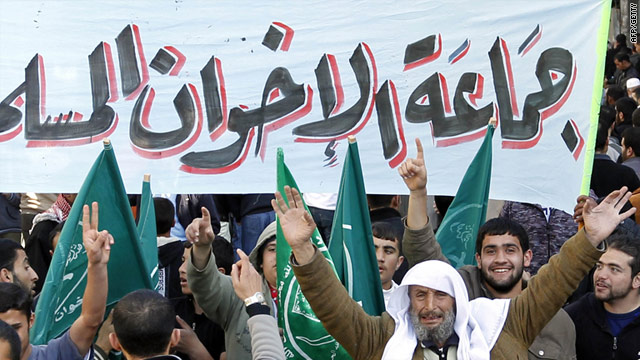

At the Clinton Global Initiative Mitt Romney said;
"Many Americans are troubled by the developments in the Middle East. Syria has witnessed the killing of tens of thousands of people. The president of Egypt is a member of the Muslim Brotherhood. Our Ambassador to Libya was assassinated in a terrorist attack. And Iran is moving toward nuclear weapons capability."
Do you notice anything off about the above quote? If it was a multiple choice question, which of the four does not fit?
a) Tens of thousands killed in Syria
b) Pres. of Egypt is in the Muslim Brotherhood
c) Our ambassador to Libya was assassinated
d) Iran is getting closer to the bomb
If the answer doesn't jump out at you then you really have been brainwashed by the American media. a) and c) involve killing innocent people and d) involves a violation of the Nuclear Non-Proliferation Treaty (if indeed Iran in pursuing the bomb), all of which are illegal. Is c) illegal? Is c) even a bad thing?
Just hearing the terms "Political Islam" or "Muslim Brotherhood" sends shivers down the spines of most Americans. But most Americans have little or no idea what the real Muslim Brotherhood actually is. A little comparative national systems analysis sheds some light.
America

In American history, despite Jefferson's "wall of separation between church and state" there was a struggle between secular and religious forces without a clear victor through much of the last century. The secular forces eventually did definitively overwhelm the religious forces (and I know the Christian Right may be active and their attempts to insert religion in our government and in our schools scare many Americans but the Christian Right is clearly an inevitably eroding minority. How many of you have grandparents that are more religious than you?). This is America, we have a separation of church and state. Here is a simple concept that every American needs to understand and never forget about the Muslim world: It is not America. America had to balance secular and religious forces for much of its history but America, to a great extent, was founded secular and secular forces were destined to triumph. The Muslim world was not founded secular and has never really been secular, long-standing regimes notwithstanding. Let's look at a few countries in the Muslim World.
Iran

For decades, in the lead up to Ayatollah Khomeini's Islamic Revolution in 1979, the corrupt Shah ran an American client state that, often subtlely sometimes brutally with his SAVAK secret police, oppressed the political religious forces of Islam, though sometimes disingenuously claiming to be propounding "true" state Islam, and empowered liberal secular forces. In America, in the second half of the 20th century and before, diverse religious political forces were waning and, with development, religion was becoming less central to everyday life with society focused on material progress. By contrast Iran, in the second half of the 20th century, was a more conservative (perhaps loosely comparable to America in the first half of the 20th century) and less religiously diverse society. In 1978-79, the long suppressed, but never extinguished, religious forces in Iran were more aggressively attacked - the Shah overreached - leading to a mass mobilization of religious and non-religious society to overthrow a leader who had become undeniably illegitimate.
The Shah failed to realize a simple fact: in an overwhelmingly Muslim nation you must balance religious and liberal secular forces if you want a stable political system.
Today, Iran is not a healthy society or a stable polity (at least not in the long-term) because they have swung to the opposite extreme of the Shah: they oppress liberal secular forces within Iran rather than co-opting them and cooperating with them.
The Shah was the worst of the dictators, he lacked Islamic legitimacy AND he was corrupt. The current Islamic regime is proving similarly dictatorial but will it soon fall? Probably not, it still has a measure of Islamic legitimacy and though it certainly has extensive elements of corruption (ranked 120th on Transparency Intl.'s Corruptions Perceptions Index, a high ranking means high corruption) its leadership is nowhere near as ostentatiously corrupt as the Shah was.
And a final note on Mahmoud Ahmadinejad, he is a populist and a provocateur. He lives off of his defiantly anti-American image. As many astute American commentators have pointed out, with the recent prophet-Muhammad-mocking video and the subsequent protests, the makers of the video were only as powerful and important as the Muslim protestors made them. The same is true with Ahmadinejad, the more Americans howl at how crazy and dangerous he is the more we empower him and make him matter. Ahmedinejad has domestic economic management power. Iranian power is somewhat opaque but it is likely that Ahmadinejad is not, ultimately, really that powerful in foreign policy and military matters (outside his populist charisma and pulpit power), the Supreme Leader Ayatollah Khamenei controls the military (General
Qassim Suleimani, commander of the elite Revolutionary Guard Quds Force seems his right hand man) and makes all decisions about Iran's nuclear program. Khamenei issued a fatwa against nuclear weapons in 2005, and Ayatollah Ruhollah Khomeini before him was so opposed to nuclear technology for Islamic reasons he froze Iran's civilian nuclear program (it was restarted after he died in 1989).
Syria
Hafez Al Assad played the same game. A staunch secularist, he long oppressed religious political forces and cast Islam as backward. The Assads, son Bashar included, have been much shrewder leaders than the Shah but, despite ruthless brutality, similarly failed to extinguish religious political forces and today those forces are actively refusing to be denied and may win or may be vanquished, but never permanently from Syrian society. Syria, sadly, may be far beyond the point of no return for the foreseeable future but the intelligent way forward for the Assad regime, or any secular regime that may succeed it - and the only hope for long-term political stability and health in Syria - is co-optation and cooperation with Islamic political forces.
In overwhelmingly Muslim nations, stability depends on secular liberal forces striking a balance with Islamic political forces.
Iraq
Saddam, a "Baathist," at least in name, followed the same script as his rival Hafez Al-Assad, championing secularism and mercilessly repressing political Islam with his dreaded
mukhabarat secret forces. It should be noted that Hafez Al Assad and Saddam Hussein were not fools, they recognized the unmatched populist appeal of Islam and regularly paid lip service, in vague generalities, to its greatness and centrality in the life and history of their country but, make no mistake, when push came to shove, political Islamist forces would be crushed.
Turkey
Ataturk was, without a doubt, both the shrewdest secular oppressor of Islam and the smartest modernizer (to be fair to its Arab competitors, among other things, it helped that Ataturk inherited a centralized state and that Turkey never had the internal divisions or inferiority complexes that colonization sows and that Ataturk started earlier, before there was any semblance of the modern Muslim international consciousness). But even in Turkey, in 2002, Islamic political forces proved they would not be denied and Erdogan's Islamist AKP came to power. Doomsday predictions of Turkey going backwards could not have proven more wrong. Islamist Turkey is booming, its economy the envy of much of the EU. And the West has absent-mindedly forgotten about Turkey's Islamism because it is not an issue.
The lesson is simple: No political system in an overwhelmingly Muslim nation can deny as fundamental a part of personal and national identity as Islam and have the legitimacy that enables lasting stability.
It is worth noting that while Turkey has lately been celebrated as an economic miracle with sound governance and Iran has been enthusiastically vilified in Western media, the two countries GDPs' are nearly identical (around $1 trillion), their populations' both around 75-80 million and on the Human Development Index (which goes beyond simple income measures by factoring in literacy and life expectancy) Iran is actually higher (88th to Turkey's 91st). Of course a good deal of Iran's wealth comes from oil but combined literacy and life expectancy measures alone still put Iran ahead of Turkey (this despite decades of US sanctions, recently tightened dramatically and joined with European sanctions).
That brings us to the lynchpin of Middle East-West relations today:
Egypt

In Egypt, Nasser, Sadat and Mubarak all played the same foolish game and oppressed the Muslim Brotherhood for almost 60 years and, of course, the Brotherhood did not go away. It is part of the fabric of Egyptian society. While America struck the cold war posture of championing peace and freedom from Soviet oppression this does not change the fact that Sadat sold off Arab dignity at Camp David, betraying popular will for Western approbation which was in itself an act of corruption that debased the Egyptian regime. First with Sadat and then with Mubarak, America systematically and financially encouraged venalism in the leadership of its Egyptian client. Eventually in 2010, when oppressive secular forces waned, coupled with an economy sputtering so badly it could produce riots, the sometimes dormant Islamists seized the opportunity and the Brotherhood came to power.
To be clear, my point is not that Islamism will always triumph. Strong currents of liberal and secular forces have also been woven into the fabric of Egyptian society for over a century. If Muhammad Mursi (who is no Ayatollah Khomeini, he got his PhD at USC and his children live in the US, whereas Khomeini lived 18 miles from Paris for 4 months and refused even to set foot in the city) fails to learn the lessons of history he will trap himself in an Islamist corner like the Iranian regime is in today, unable to successfully co-opt and cooperate with liberal secular forces and thus forced into a protracted and mutually deleterious struggle.

Or perhaps, Mursi will follow the lead of the Islamist Erdogan, as he obviously will reassure Western audiences ad nauseum, and cooperate with secular forces - harnessing Islamic and secular forces to the same national ship and seeking harmony and mutual respect between them. There are real and legitimate concerns in the West, and inside Egypt itself, about the degree to which the Brotherhood will protect, neglect or undermine the rights of Coptic Christians and women. Concerns about how much the Brotherhood administration will, in pandering to - or perhaps struggling against it remains to be seen - extremist Salafist Islamic voices, oppress and censor secular liberal voices. It is this dimension - Mursi and the Brotherhood's skill iny walking the tightrope between maintaining Islamic legitimacy without antagonizing Salafists and simultaneously incorporating Egyptian liberal secularists - that will determine the fate of the Egyptian experiment in democracy and Egypt's Islamist government. All this while stirring nationalism without being pulled into confrontation with Israel. It is an exceedingly delicate balancing act and an unenviable task
For the sake of Egypt and the world let us all hope that Mursi does not slip into a battle with liberal secular forces (or for that matter with Salafist forces) but rather extends a hand to both and sets about the massive task of recovering from Mubarak's parasitic reign and building the Egyptian nation - harnessing the prodigious strength of both Egypt's Islamic and its liberal secular forces.
This is a very simple, very old, very familiar argument, it is nothing more than arguing that representative government is the best system (which makes it all the more bewildering that it is so difficult to convince Americans of this point in relation the Muslim world). To build a better nation, governmentally and politically you must make allowances for the power dynamics that exist within society without succumbing to them entirely.
If instead Egypt slips to either the Islamist extreme under the Brotherhood or to the opposite secular extreme under the Brotherhood's successors Egypt may spend decades wallowing in stagnation, fighting itself, like it has for decades. But if, on the other hand, this all-important Islamist-Secular Liberal balance can be struck, in 20 years, Egypt can be a world power and the Arab Spring will have unequivocally redeemed itself in the long lens of history.
This is not to oversimplify the task, the point is only that a government of Islamist-Secular cooperation is
necessary but not a
sufficient condition for a prosperous Egypt. With this hurdle cleared, prosperity is only possible, the success of an Islamist-Secular (if this term seems like an oxymoron, substitute "Liberal" for secular, this is a general argument because the details confuse us) government will depend on the wisdom of government decision-making, like it does in all countries not riven by this tension. Even an Islamist-Secular cooperation government will operate in an Egypt faced with a bewildering array of profound problems, and without the money to implement sweeping change. All these challenges are daunting but whether or not Egypt can somehow manage to find a way to share power is the axis on which Egypt's future hinges.


Comments